By Reece O’Dell
The Wornall house is currently surrounded by the homes of Kansas City residents and the quaint shops of Brookside. When the Wornall home was first built in 1858, it was surrounded by 500 acres of farmland and one small log cabin, where the Wornall family originally lived. As Roma Johnson Wornall, John Wornall’s third wife, said, “I have seen so many changes. I lived in the Wornall Homestead when it was surrounded by a 500-acre farm, now I live in it surrounded by a city. It seems in the centre of the city.”
The true architect of the Wornall house is unknown, as historians are hesitant to attribute the role to anyone without strong documentation. The lack of any record of the architect sparks curiosity among historians everywhere. There is an account of the family of Asa Beebe Cross, a well-known architect in the Kansas City area, who is attributed as the architect, but historians are unsure of its authenticity.
Cross was born in New Jersey in 1826. When he was twenty-one, he entered the office of A. B. Stone in New York City, where Cross’ studies at the business laid the foundation for his knowledge of Greek Revival forms. After two years of studying under A. B. Stone, Cross moved to St. Louis to finish his studies under John Johnson. Cross’ studies in St. Louis may well have influenced his knowledge of Kentucky, Italianate, and Gothic styles of architecture. Cross arrived in Kansas City on April 23rd, 1858, seeking to grow his business. It is not certain if and when the meeting between Wornall and Cross took place to build the Wornall home. It is possible that there was a previous contract between the two before Cross’ arrival in the Kansas City area, although there is nothing in Cross’ or Wornall’s records that dictate this. A fact we do know, however, is that the Wornall home was built the very same year that Cross arrived in the area.
If Cross was the true architect of the Wornall house, it would make sense that he would incorporate the styles he learned in St. Louis, such as the Gothic and Kentucky styles, when designing the home. Because of his knowledge of the Kentucky form, in particular, it may have been likely that Cross was influenced by John Wornall to make certain aspects of the Wornall home resemble the Kentucky farmhouses Wornall had known as a boy.
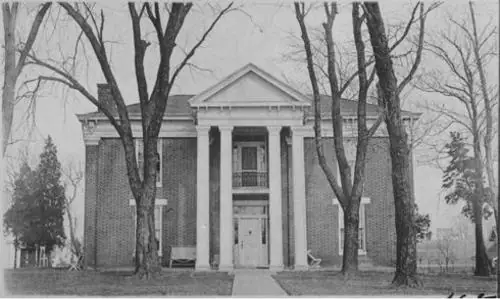
The Wornall home was built in 1858 in the Greek Revival style, a style that was popular during the first half of the 19th century. The style was based on 5th-century Greek temples, a design that was growing in awareness with the recognition of Greek culture and art, such as the Parthenon in Athens. The Greek Revival style homes, like the Wornall home, were usually rectangular in shape and the “temple front” usually faced the street. In the Wornall’s case, their home faced the “Road to New Santa Fe,” which is now Wornall Road. The front doorway of Greek Revival homes were usually flanked by columns or pilasters and had either a transom window or a 3-part entablature. The Wornall home has columns and a transom window surrounding the front door into the foyer, where guests from past to present are greeted. To see the beautiful architecture of the home and learn more about its history, plan a visit to the John Wornall House Museum.