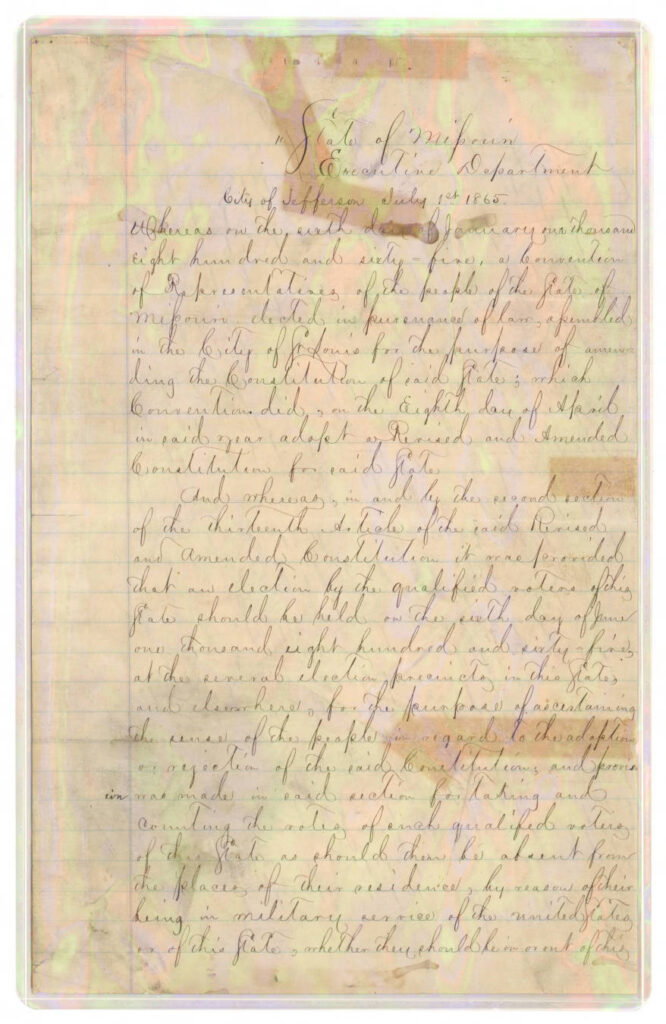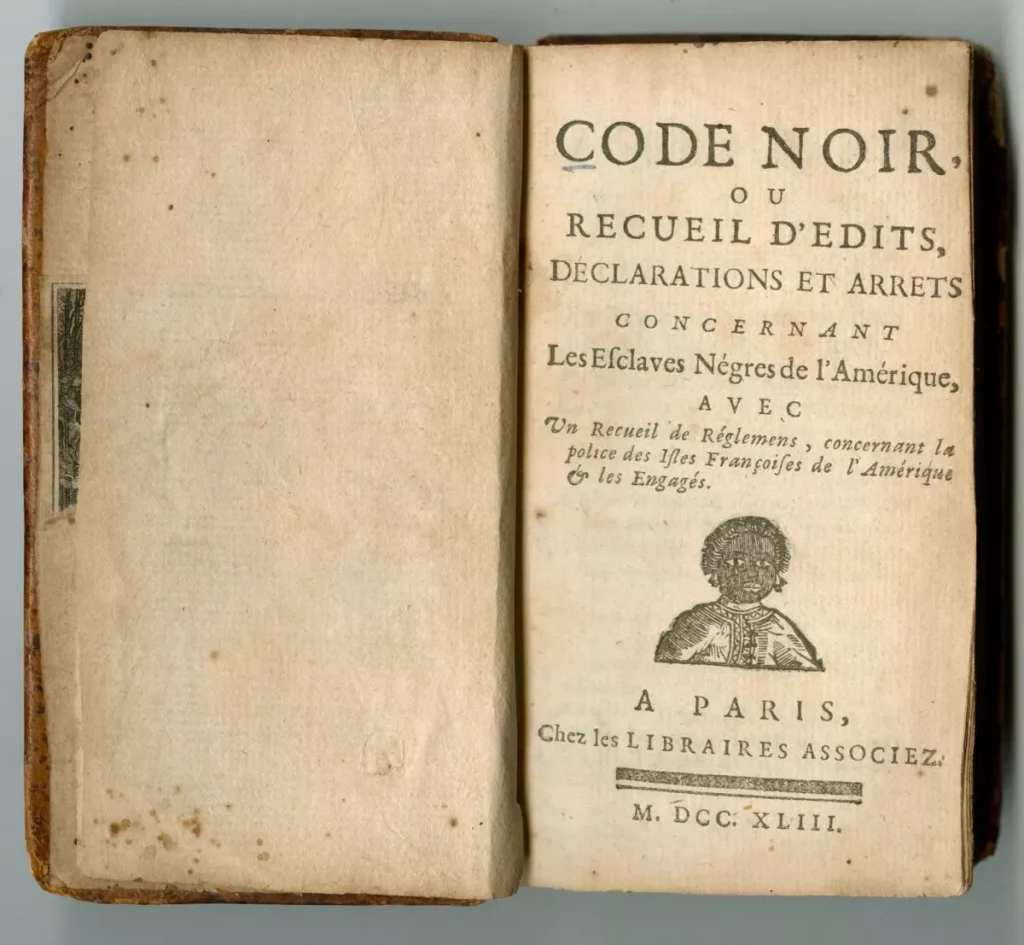
The legal framework for slavery in Missouri stretched from the start of French Colonial rule in 1685 to the outlawing of enslavement in the United States in 1865. Over 180 years of law shaped the institution of enslavement in the state.
Under French colonial rule, enslavement in the land that would become Missouri was governed in part by the Code Noir. Established under Louis XIV the Code was a series(?) of laws that regulated enslaved and free Black people in France’s colonies. The Code Noir stated that:
- Enslaved people were property under the law.
- Enslaved people were forbidden from carrying weapons, gathering with enslaved people from other households, or selling goods without a master’s written permission.
- Enslavers could chain and beat those who they enslaved.
- If an enslaved person struck a member of the family that enslaved them, they could be executed.
However, enslaved people were given limited protections.
- Enslavers were required to provide food and clothing.
- Elderly and ill enslaved people must be provided care.
- Enslaved people could not be tortured or mutilated.
- Husbands, wives, and prepubescent children under the same master could not be sold separately
- Enslaved people had the legal right to bring lawsuits.
After the Louisiana Purchase was completed in 1803, the Territorial Government of Missouri replaced the Code Noir with the Black Codes. These codes applied to both free Black individuals as well as enslaved people.
Enslaved people required written passes to leave an enslaver’s property; unauthorized assembly among Black people was punishable by public whipping. Weapon possession required a judge’s written approval. Any commercial interaction with a free person — Black or white — depended on an enslaver’s consent. Those who transported an enslaved person by ship without authorization faced a $150 fine, and the enslaver retained the right to sue for damages, treating the person as lost goods. However, Black individuals who were unfairly enslaved retained the right to sue those enslaving them. Hundreds did so.
Missouri statehood in 1821 brought a new set of laws. A slew of new rules was created in 1825. That year a Black person was defined as anyone who had at least a quarter “negro blood.” County courts were ordered to have patrols monitor enslaved people at home as well as any place they might gather. If an enslaved person was discovered more than 20 miles from their enslaver’s property they were considered a runaway. Runaways were to be taken to the county courthouse where they would be held for a month or until their enslaver came for them. If an enslaver did not appear, the court would sell them.
During the 1837 sessions Missouri made it illegal to publish or circulate positive opinions about abolition. Guilty parties were first given a fine of up to $1,000 and two years in jail. Anyone convicted a second time would face 20 years imprisonment. A third conviction meant life imprisonment.
Three years later, rewards were issued to encourage the capture of runaway enslaved people. Slave catchers would receive a reward of between $25 and $100. Enslavers now had three months to collect the enslaved person. The sentence for assisting an enslaved person towards freedom was increased to five to 10 years.
When the U.S. Civil War began, Missouri’s status as a Union state had a direct consequence for the enslaved people within its borders. The Emancipation Proclamation issued by President Abraham Lincoln on January 1, 1863 only applied to states that had seceded from the Union. Since Missouri was a Union State, although tenuously, the Proclamation did not apply to those enslaved in Missouri.
On January 11, 1865 Missouri delegates at the Missouri Constitutional Convention approved an ordinance ending enslavement in Missouri. Three weeks later, the 13th Amendment was submitted to Congress. The amendment read: “Neither slavery nor involuntary servitude, except as a punishment for crime whereof the party shall have been duly convicted, shall exist within the United States, or any place subject to their jurisdiction.”
Missouri was the eighth state to vote to ratify the 13th Amendment on February 6, 1865. The Amendment went into effect on December 18, 1865 finally ending enslavement in Missouri.