Indigenous prehistory refers to everything that occurred before the first recorded contact with Europeans. In Missouri, the first contact was with French fur traders in 1673. Prior to that, several indigenous groups called the Missouri area home: the Otoe, Missouria, Osage, Kansa, and Ioway all lived primarily within the state’s modern boundaries. Because of their shared geographic location, these groups had cultural overlap. But aside from their geography-based cultural overlap, they all evolved from a single, “prehistoric” culture known as Oneota.
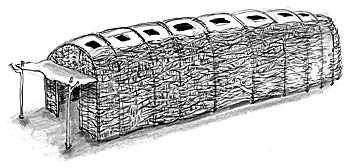
The Oneota culture was shared between indigenous people across the eastern Great Plains, Upper Mississippi River Valley, and Great Lakes region between 900 – 1650 CE. Owing to their geography across plains, valleys, and riverbanks, the Oneota were adaptable to living in forests, grasslands, and wetlands. They were semi-sedentary, meaning they lived in villages but also traveled away from home during hunting seasons. They had various home styles, including small, single-family wigwams and large, multi-family longhouses. The men hunted and fished smaller game like deer, turkey, and waterfowl as opposed to big game like bison or elk. They also made tools, conducted trade, and engaged in warfare. Women farmed, cooked, made clothing, and cared for children.
Indigenous groups that evolved from the Oneota culture share an oral history that traces the Oneota culture back to a single community of people, rather than merely a shared culture between different, distinct groups. Missouria, Ioway, and Otoe oral tradition says the Oneota was a single group of people living along Lake Michigan who left the Great Lakes area and moved down the Mississippi River. The Ioway broke off when they reached northern Illinois and settled by the Rock River. The Missouria and Otoe settled together at the mouth of the Grand and Missouri Rivers. Eventually, the Otoe moved north towards the Missouri-Nebraska border while the Missouria remained at the river’s mouth. While these three groups have laid the strongest claim to their shared Oneota past, other Missouri peoples, like the Kansa and Osage, have also traced their origins to both the prehistoric Oneota culture and the joint community said to have come from the Great Lakes region.