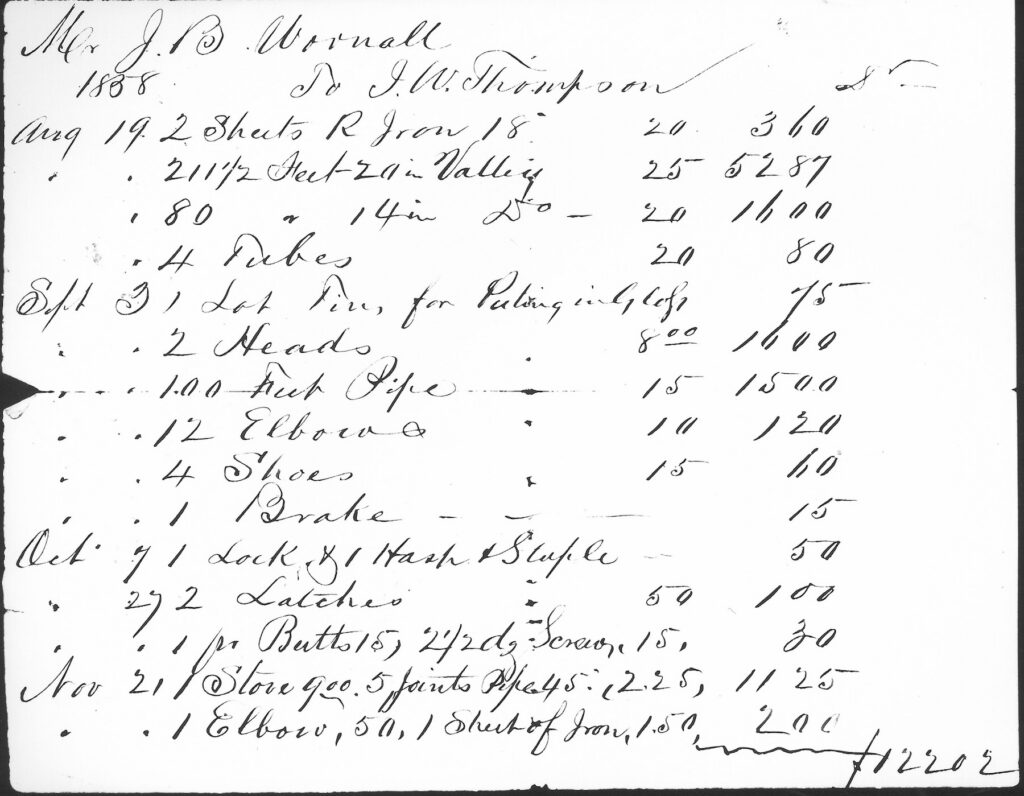
When John Wornall built his grand mansion in 1858, he also constructed several outbuildings, including barns, stables, a smokehouse, an outhouse, and a carriage house.
The Wornall property’s size changed over time as John Wornall bought, sold, and rented land in the area. By the time of his death in 1892, approximately 150 acres remained, which were inherited by his widow, Roma J. Wornall. She sold the land and the Wornall House to developer J.C. Nichols in 1909 but repurchased the house in 1911, most likely because city utilities were available for the first time.
That year, she turned her attention to the site of the former carriage house. In an article titled “This for Remembrance,” published in the Kansas City Star on July 16, 1911, Roma remarked, “I guess we can’t avoid it…but I’m afraid we will have a garage where the old carriage house stood. But I know the spirit of the old home will forgive us that, for there will be a pergola leading to it, all covered with clematis, purple clematis.”
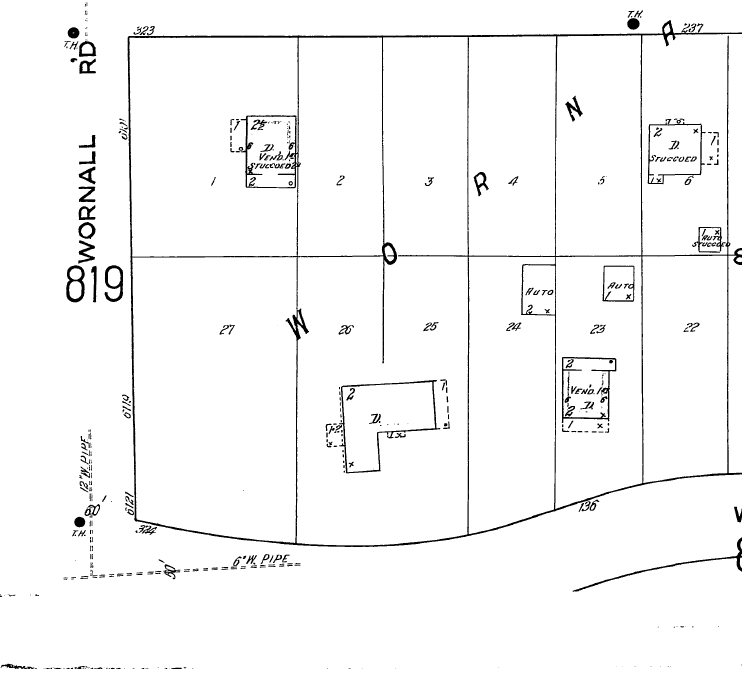
Six years later, her plans came to fruition. The name on the building permit is C. Wornall—Charles, Roma’s youngest son. The carriage house also appears as a garage in the 1917 Sanborn Fire Insurance maps, labeled simply as “auto.”
Ostensibly, the structure was built for Roma’s car and a full-time driver. The carriage house’s second floor was a small apartment where the driver could live.
Roma was also rumored to be the first woman in Kansas City to own a car, though this has not been verified and the origin of the rumor is unclear.
Roma’s granddaughter, Roma Virginia Wornall Powell, recalled, “She loved her home and loved to drive her electric car from her home to Westport. She drove her electric until she was 80. She rang the bell at every intersection and always kept a rose in the bud vase.”
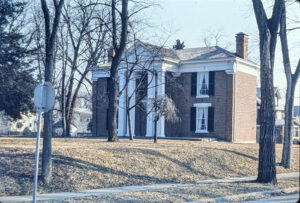
When the Wornall House became a museum, the Jackson County Historical Society began calling the garage the “carriage house.” The earliest references to this name appear in several 1973 news articles about the Westport Garden Club’s garden party, a benefit for the Wornall House.
The museum opened the carriage house as a gift shop in August 1973, calling it “J.W.’s Cobweb Corners.” It has since served as a programming space, storage area, and gardening shed for the Wornall House to this day.
The house was nominated for the National Register of Historic Places in 1969 and placed on Kansas City’s register of historic places in 1978. Neither nomination form mentions the carriage house, and it is not part of the home’s historic designation.