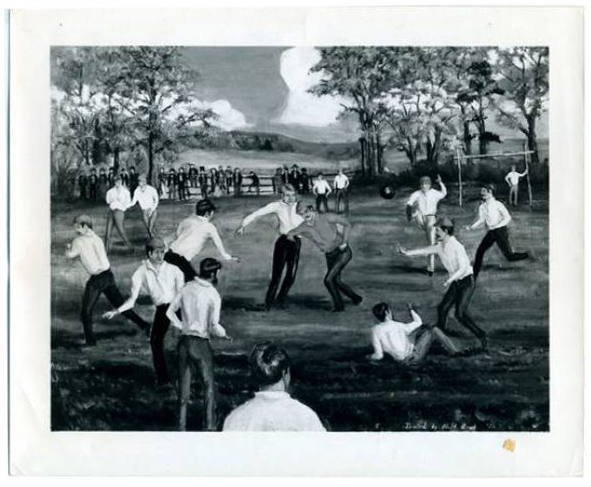
Love for soccer is not a modern phenomenon in the United States. Like so many traditions, it began taking root during the Victorian era. In the mid-1800s, European immigrants brought the beautiful game and other forms of football with them.
As time rolled on, love for the game grew:
- 1862: The Oneida Football Club of Boston debuted and is widely regarded as the first organized football club in America. Their version of the game was a local “Boston game,” blending elements of soccer and rugby.
- 1864: What is believed to be the first match played under official rules in the United States took place in Waukesha, Wisconsin. A team from Carroll College faced a local side, with the students winning 5–2.
- 1869: Princeton and Rutgers played the first intercollegiate football game in the United States.
As the 1870s rolled on, football began to take on distinctly American paths. While elite colleges gradually drifted toward rugby-style football that eventually evolved into American football, working-class towns and immigrant communities embraced football with passion.
Soccer became a weekend ritual in places like St. Louis, Missouri. Factories shut down on Saturday afternoons, and workers gathered to play and watch. By 1883, that passion had grown into structure. In St. Louis, the Western Football Association was formed and is generally regarded as the country’s first organized soccer league.
The following year, in 1884, the American Football Association was founded in Newark, New Jersey. The AFA became the first national soccer governing body in the United States and one of the earliest established outside the British Isles.
It was time for trophies. In 1885, the AFA launched the American Cup, the nation’s first national knockout tournament. The inaugural winners were ONT of Kearny, New Jersey, a club that established itself as one of the first great soccer powers in the United States.
By the 1890s, soccer’s momentum was undeniable. The game had leagues, cups, and passionate fans. Enter the first professional leagues.
In 1894, the American League of Professional Football made history as the country’s first professional soccer league. It was ambitious, ahead of its time, and short-lived, folding after only a few weeks.
The following spring, the National Association Football League began play in the Northeast. Despite interruptions and reorganizations over the years, it became one of the longest-running soccer leagues in American history.
As the Victorian era gave way to the 20th century, soccer entered its first golden age in America.
In 1905, an English amateur side known as the Pilgrims toured the United States, drawing large crowds and helping sustain growing interest in the sport. By 1906, the American Cup and the National Association Football League had resumed, with New Jersey’s West Hudson team dominating many of the early competitions.
Then came a watershed moment. In 1913, the United States Football Association was founded. It would later become U.S. Soccer. Just a year later, in 1914, FIFA granted the USFA membership.
That same year, the National Challenge Cup was launched, a tournament now known as the U.S. Open Cup. It remains the oldest continuously contested national soccer competition in the United States and one of the oldest team sport tournaments in the country—a living link to the game’s Victorian roots.