Though Missouri officially joined the Union, it remained deeply divided during the Civil War. After pro-Confederate governor Claiborne Fox Jackson was exiled in 1861, Missouri’s government had a Republican majority that supported the Union cause and the abolition of slavery. By 1864, members of the government and so-called “Radical Republicans”––those who wanted immediate abolition, black civil rights, and strong punishments for Confederates––voiced support for a convention to bring about emancipation in Missouri.
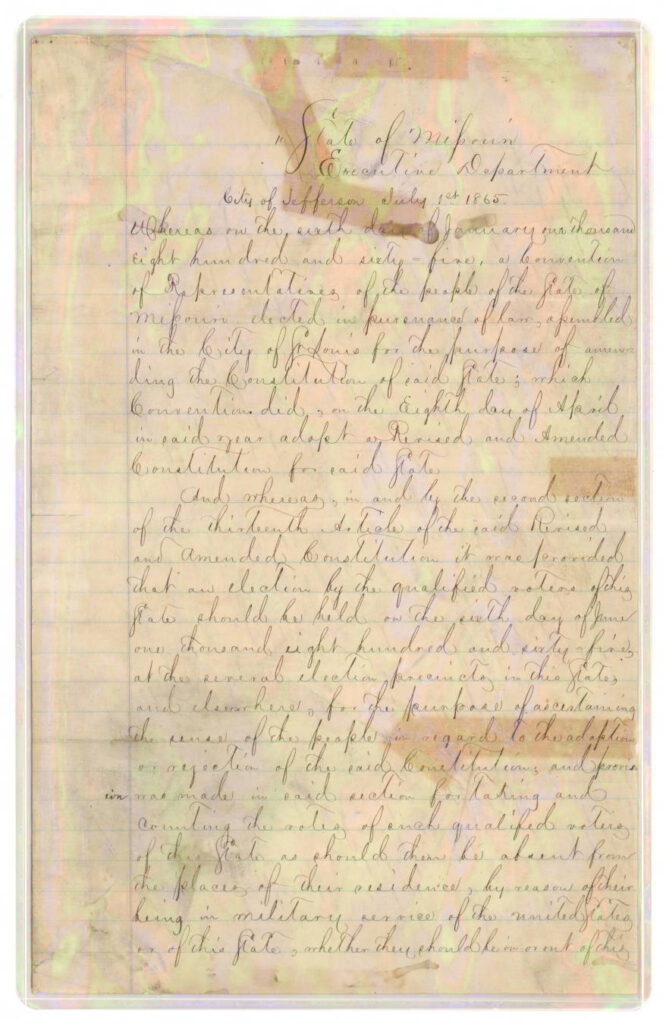
In January 1865, before the Civil War officially ended, Missouri lawmakers met in St. Louis at a convention for the creation of a new state constitution. The new constitution was primarily intended to make the emancipation of slaves possible. It was also intended to show that Missouri’s politicians were committed to the Union during and after the war. On January 11, the convention passed an ordinance abolishing slavery throughout the state. The amendment to Missouri’s constitution came three weeks before Congress passed the 13th amendment to the U.S. Constitution abolishing slavery across the country, although neither amendment went into effect until December of 1865.
Missouri’s Constitutional Convention wanted to show the federal government that Missouri was ready and willing to integrate a free black population into its society. While it set the stage for Reconstruction to take effect in Missouri, it also exacerbated the existing divide between Union loyalists and pro-Confederates. Aside from emancipating slaves and making it legal for African Americans to receive an education in Missouri, the new constitution also included a section of sworn allegiance to the Union and excluded the voting rights of former Confederates and black men.
Because of Missouri’s early cooperation with the Union’s policies that secured civil rights and legal protections for African Americans, as well as its loyalty to the Union during the war, Missouri didn’t see federal intervention during the Reconstruction era like other former slave states did. Yet the exclusion of former Confederates and rebels from voting, effectively barring them from engaging in state politics, created instability. The “Little Dixie” region along the Missouri River particularly struggled with the post-war transition, since slavery was heavily tied to the area’s economic output and over half of Missouri’s enslaved population had resided there.
Although the 1865 Constitution still maintained racial divisions and segregation throughout the state, it welcomed the effort to integrate free African Americans into society and began rebuilding the Union through Reconstruction.