John Wornall felt as though he was traveling at a breakneck 1,400 miles per hour when he trialed a wind wagon. He was tasked with steering the innovative contraption, joined by a small group of adventurous passengers.
Weighing just 350 pounds—light for a wagon—these vehicles measured three feet wide, eight feet long, and six inches deep. The sail was hoisted above the front axle, which was used to steer. Reports estimated that wind wagons could travel between 15 and 40 miles per hour.
The first mention of a wind wagon appeared in a Westport newspaper in April 1859. Its arrival and departure, under the direction of its creator, Captain Thomas, reportedly drew a crowd, with 15 brave souls giving the device a trial run.
When one arrived in Council Grove, Kansas, after departing Westport in 1860, a newspaper remarked, “Who says now that the Santa Fe road is not a navigable stream?” It was estimated that the wagon would soon make the 125-mile trip regularly in just 48 hours.
Wind wagons appeared in other locations as well. Notably, a Kansan built one that carried a party of four from Oskaloosa to the Pike’s Peak Gold Rush in 1860.
John’s 1887 recollection remains one of the most vivid accounts of wind wagon travel. He described boarding the craft and being handed the steering handles. As wind filled the sails and the wagon sped down the road, the passengers congratulated each other exuberantly.
However, as the wagon picked up speed, John grew uneasy. He urged the creator to slow down, but his plea was refused. Approaching a washed-out section of road, John considered jumping off, but the group miraculously sailed over the gap at an estimated 40 miles per hour.
Only a few wind wagons were ever created; the vehicles remained a fascination rather than growing into a popular means of travel. Despite this, Disney immortalized them in a short video called Windwagon Smith set in Westport.
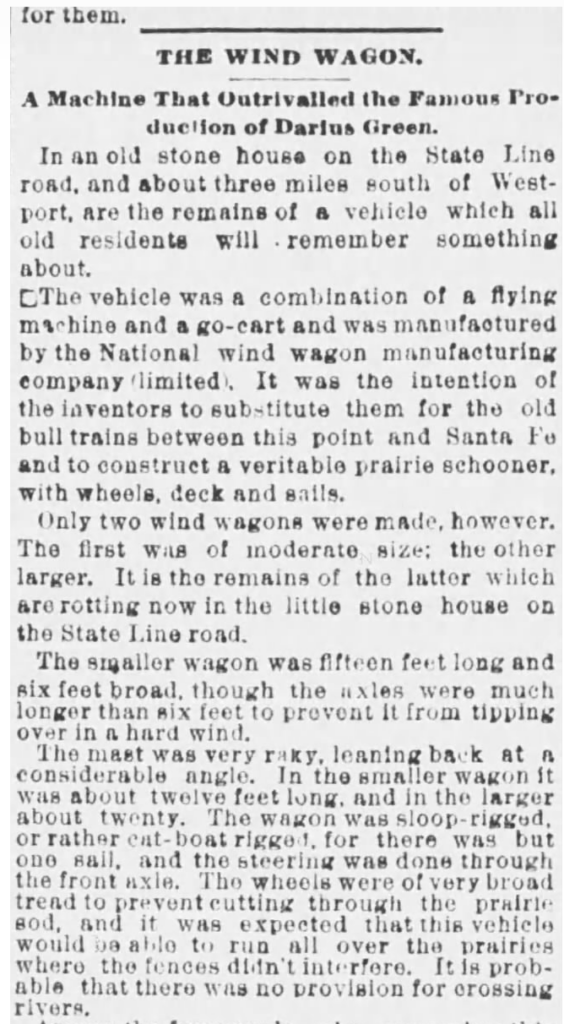
You can read John’s full account from the April 25, 1887, edition of the Kansas City Times below.
THE WIND WAGON.
A Machine That Outrivalled the Famous Production of Darius Green.
In an old stone house on the State Line road, and about three miles south of Westport, are the remains of a vehicle which all old residents will remember something about.
The vehicle was a combination of a flying machine and a go-cart and was manufactured by the National wind wagon manufacturing company (limited). It was the intention of the inventors to substitute them for the old bull trains between this point and Santa Fe and to construct a veritable prairie schooner, with wheels, deck and sails.
Only two wind wagons were made, however. The first was of moderate size; the other larger. It is the remains of the latter which are rotting now in the little stone house on the State Line road.
The smaller wagon was fifteen feet long and six feet broad, though the axles were much longer than six feet to prevent it from tipping over in a hard wind.
The mast was very raky, leaning back at a considerable angle. In the smaller wagon it was about twelve feet long, and in the larger about twenty. The wagon was sloop-rigged, or rather cat-boat rigged, for there was but one sail, and the steering was done through the front axle. The wheels were of very broad tread to prevent cutting through the prairie sod, and it was expected that this vehicle would be able to run all over the prairies where the fences didn’t interfere. It is probable that there was no provision for crossing rivers.
Among the few people who remember this machine is Mr. John B. Wornall of Westport. He was one of the pioneers in wind-wagoning.
“I steered that thing on its trial trip,” said Mr. Wornall to a Times reporter, “and it was very lively traveling. You see certain members of the company had built wind mills around this country for some time, and built good ones too, so we had almost perfect confidence in our ability to handle wind in almost any way we wanted to.”
“Well, any how I agreed to steer the chariot and some one else was to take care of the sailing gear; so we rolled her out in the road and I took hold of the handles. She was steered by the front axle just like a bob sled. We pulled in the sheet and the wagon began to move off down the road. We were quite pleased, and congratulated each other in the most exuberant way. A little more wind came along and we went a little faster. Then the wind blew a little harder, and we did not do so much congratulating but did a little more steering. It seemed as if the wind had put a job on us, for it kept blowing harder and harder, and the machine kept going faster and faster, and it seemed as if I couldn’t do steering enough. So I said:
“‘William’ — I believe that was the name — hadn’t you better let out that sheet a little bit?”
“No, I guess she’s all right, if you can hold her,” said he.
“Why, certainly,” said I.
But we kept going faster and faster, and I said:
“William, let out that sheet, will you?”
“O no,” he said, “you can hold her.”
“But William,” said I, “there’s a big washout ahead of us, and we’ve got to stop.”
“Hold her to it,” said he, “she’s running bully now.”
“But we’ll all be killed!” I screamed.
“Hold her to it.”
There wasn’t much else for me to do. I couldn’t stop steering, and as for jumping off, that was out of the question. I could not luff up into the wind, for there was a high rail fence on the windward side of the road, though judging from later developments I am satisfied that I could have sailed through the fence without injury. We got to the washout rightaway and that washout was ten feet deep and ten feet wide,” said Mr. Wornall with great candor, and looking the reporter in the eye as a guarantee of his veracity.
“Well, sir,” he continued, “the machine never phased the hole. We never knew we were over until we took a breath and kind of reasoned it out that we were. You see the masts being set so terribly raky, the wind would lift the machine up, and several times I had seen and felt one of the wheels leave the ground, and I believe that was our salvation. That is why we got across that washout.”
“How fast did you travel?”
“I thought at the time that it was at the rate of about fourteen hundred miles an hour, but I really don’t suppose it was much over forty. I only judge from the fact that there was a man mounted on a horse, and a very good horse it was too, following us and trying to keep up, but the horse was left so badly that when I happened to glance around and saw him, I actually thought he had turned around and was running the other way.”
“We ran along down the road until we got beyond fences and then I luffed up into the wind and stopped her and after I had caught breath enough I asked my associate what he meant by exposing a married man to such horrible risks and gave him a piece of my mind that would have blown his invention into little bits if it had been turned into wind. I am satisfied now that I could have just luffed up and gone right through that seven rail stake and rider fence without injury. We were going so fast that we would have just cut through it. It stands to reason that if we crossed a hole ten feet wide we could have gone through a fence that was only one rail thick.”
“When was the other wagon, the large one made?” asked the reporter.
“Let me see,” said Mr. Wornall, “Kumpf was elected mayor two weeks ago last Tuesday. Cleveland was elected in ’84, a distant relative of mine was married in ’75, the Franco-Prussian war took place in ’70, Sumter was fired on in ’61 and it was in ’53 that these wind wagons was made. That was before the war. Yes, m ’53.”
“The other wagon was a double-decked arrangement and it was intended to have it run through to Santa Fe. I know there was a hunting party made up and the wagon started off in good shape. It did not get through to Santa Fe but it did run a long ways in that direction and the party had lots of sport. They reported that shooting was not a great deal of fun, but that the great sport was in running down a coyote with the wind wagon, and that they only used their guns when hunger compelled them to.”
“The last run the wind wagon ever made was when it started to carry about twenty people for a picnic about twenty miles away. The wagon ran only a short distance when it became becalmed in a hollow, and remained there for a long time, until someone took pity on the old machine and removed it to its present tomb, where it has fallen to pieces.”