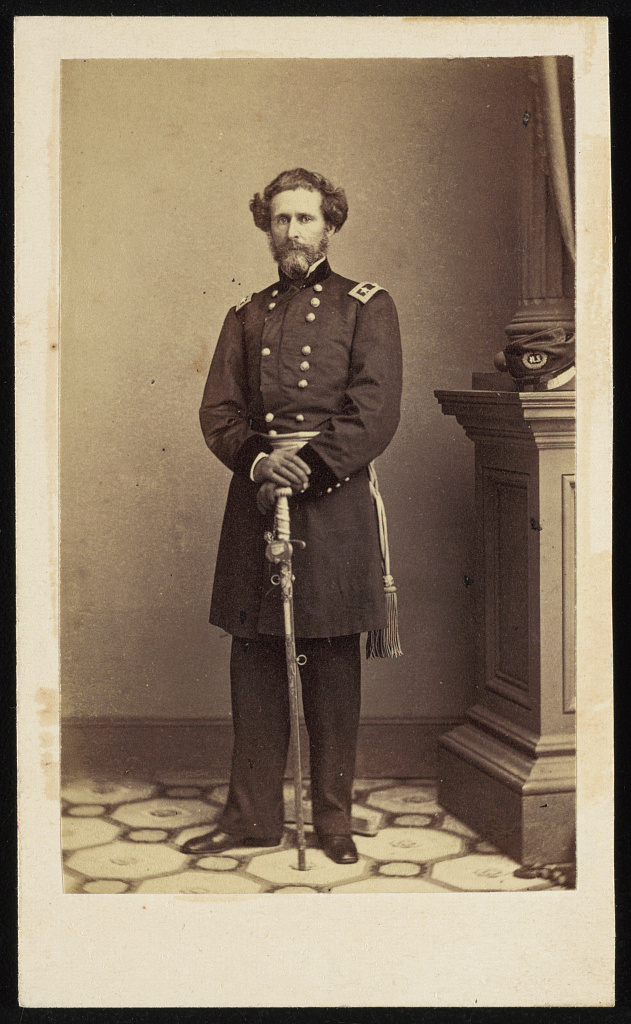
When researching Wornall/Majors staff tend to develop platonic crushes on historical figures. For Valentine’s Day 2026, they are sharing them. Up first is Director of Programs Sarah Goebel, who sometimes cannot stop talking about Major General John C. Frémont.
Major General John C. Frémont was known for defying authority, a trait that became especially evident during the U.S. Civil War. In 1861, after the war began, Frémont declared martial law in Missouri and emancipated enslaved people in his jurisdiction, signaling the possibility of recruiting Black soldiers despite federal restrictions. President Lincoln revoked his emancipation order just 12 days later, worried about keeping border states loyal to the Union.
Born in 1813 in Savannah, Georgia. At age 24, he joined the U.S. Army Corps of Topographical Engineers as a second lieutenant. Over the next decade, he led five expeditions across the American West, including mapping the Oregon Trail. During the Mexican-American War (1846–1848), he defied Mexican authorities by raising the U.S. flag at Frémont Peak and participated in the Bear Flag Revolt. After hostilities ended in Southern California, Commodore Stockton named him military governor, but Army General Stephen W. Kearny contested this authority. Frémont refused to relinquish command, resulting in his 1847 court-martial for insubordination and mutiny. Although convicted, he was pardoned by President Polk and resigned his commission in 1848. In 1847, Frémont acquired land in Mariposa, California, where gold was discovered in 1849.
In December 1849, Frémont became one of California’s first two U.S. senators from the new state. During the presidential election of 1856, Frémont was nominated by the Republican Party and campaigned with the slogan “Free speech, free press, free soil, free men, Frémont and victory!” He lost to Democrat James Buchanan, who won 174 electoral votes to Frémont’s 114.
When the Civil War began in April 1861, President Lincoln appointed 48-year-old Frémont as a Major General, placing him in command of the Department of the West, based in St. Louis. He was responsible for holding Missouri for the Union, despite having only 23,000 enlisted men. Frémont declared martial law on September 12, confiscated rebel property, and on August 30 issued an emancipation order for enslaved people in his department.
The Federal Militia Act of 1792 prohibited Black men from military service. President Lincoln’s administration feared that changing this policy might drive more border states to secede. By issuing his emancipation order, Frémont directly challenged this cautious approach and implied the possibility of Black recruitment.
Twelve days later, on September 11, President Lincoln revoked Frémont’s emancipation order. Supply shortages and defeats at Wilson’s Creek further weakened his position, and he was relieved of command in November 1861. Frémont blamed political intrigue for his dismissal.
In 1862, Frémont took command of the Mountain Department in western Virginia. He pursued Confederate General Stonewall Jackson for eight days, clashing at Cross Keys on June 8 but failing to defeat the Confederate force. When placed under the command of junior General John Pope, Frémont resigned in protest, citing both seniority and personal animosity. With no further reassignment, he left the military in 1864.
A faction of abolitionist Republicans known as the Radical Democratic Party nominated Frémont for president, but he withdrew before the election to support Lincoln’s reelection. After the Civil War, Frémont lost much of his wealth, investing in the failed Pacific Railroad in 1866 and suffering further losses during the Panic of 1873. From 1878 to 1881, he served as territorial governor of Arizona, appointed by President Rutherford B. Hayes. His financial troubles continued until his death in 1890, with support from his wife Jessie’s writings.