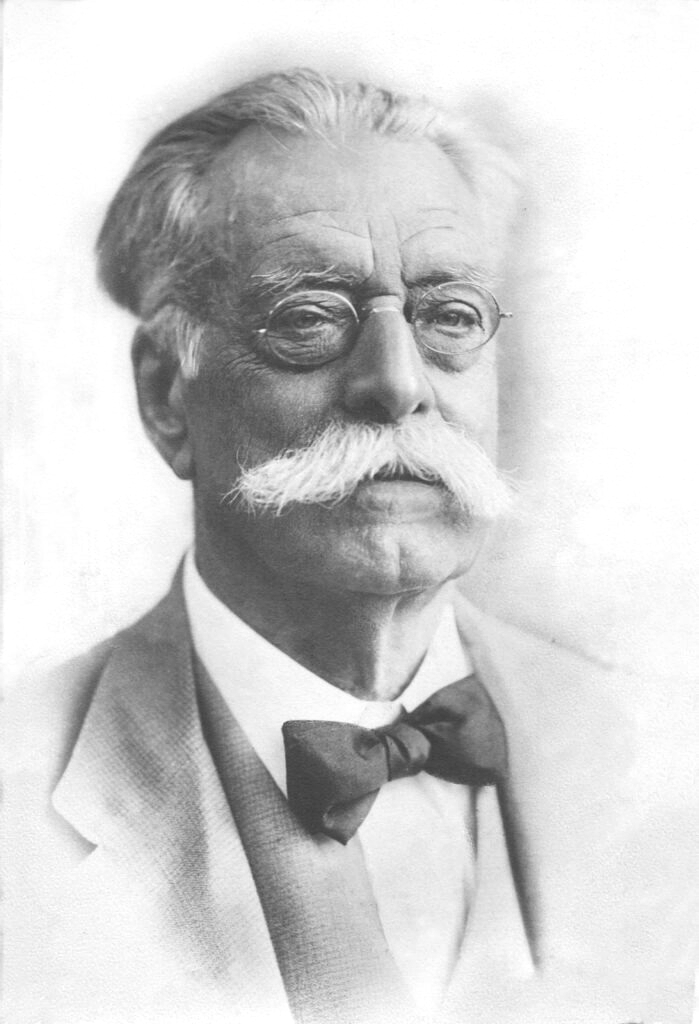
While doing research for our September Drink Your History Event, our Director of Community Engagement, Jackie Berry, came across Emilio Bacardí Moreau, the second-generation head of the rum distillery Bacardi. While Bacardi was already a well-known brand in Cuba, Emilio was the one to begin the international dominance of his family name. Unfortunately, she was only able to put a small bit of his fascinating life into the official presentation, but she was left with lots of Emilio Bacardí Moreau knowledge rattling around in her head.
Emilio Bacardí Moreau was born on June 5, 1844 in Santiago de Cuba, the first son of Facundo Bacardí Messó, founder of Bacardi Rum. Early in his life, the Bacardi family moved back to Spain to avoid a cholera outbreak. During his time in Spain, Emilio became interested in politics, poetry, religion, and art as well as the liberal politics of the day, including democracy, abolition, and the criticism of organized religion.
During his time in Spain, Emilio became interested in philosophy and poetry, having a particular interest in theosophy, a belief system structured around direct, individual communication with a higher power through physical and mental rituals rather than organized religious structures, something very uncommon in Spain and Cuba, both highly Catholic countries.
Emilio was about 17 when he returned to Cuba, years after the rest of his family, and as the first-born son, was given a high-ranking position in the Bacardi company. While Emilio’s passions may not have originally lain in business, he was the one to take Bacardi Rum international, expanding far beyond its previous reach.
While expanding the business, Emilio worked hand in hand with Cuban revolutionaries intent on gaining independence from the Spanish Empire. He used his business as a cover and funneled money to rebel groups, all while helping to develop a communication network. Both Emilio and his father were imprisoned several times by the Spanish authorities with Emilio spending up to four years in prison, according to some sources, both for aiding the rebels and fighting in the rebel army against Spain in the Cuban War of Independence. After the Spanish-American War, Emilio became the first democratically elected mayor of Santiago in 1901. During his tenure, he built public parks and monuments, expanded social programs, and established schools and hospitals. In 1906, he was elected to a national senate seat.
Upon his death in 1922 at the age of 78, Santiago de Cuba shut down all public events for two days to honor and mourn the death of “Cuba’s foremost son.” About 20 years before his death, he had established the Museo Municipal Emilio Bacardí Moreau, the oldest museum in Santiago de Cuba and a tribute to the Cuban War of Independence as well as a repository for art and cultural artifacts including the first Egyptian mummy in Cuba, French modernist art, objects from Bacardi, pre-Columbian Cuban artifacts, and reportedly three death masks of Napoleon Bonaparte. After his retirement from public service, Emilio focused on correspondence with his family, reading, and writing his series of novels Crónicas de Santiago de Cuba, published in 1908.