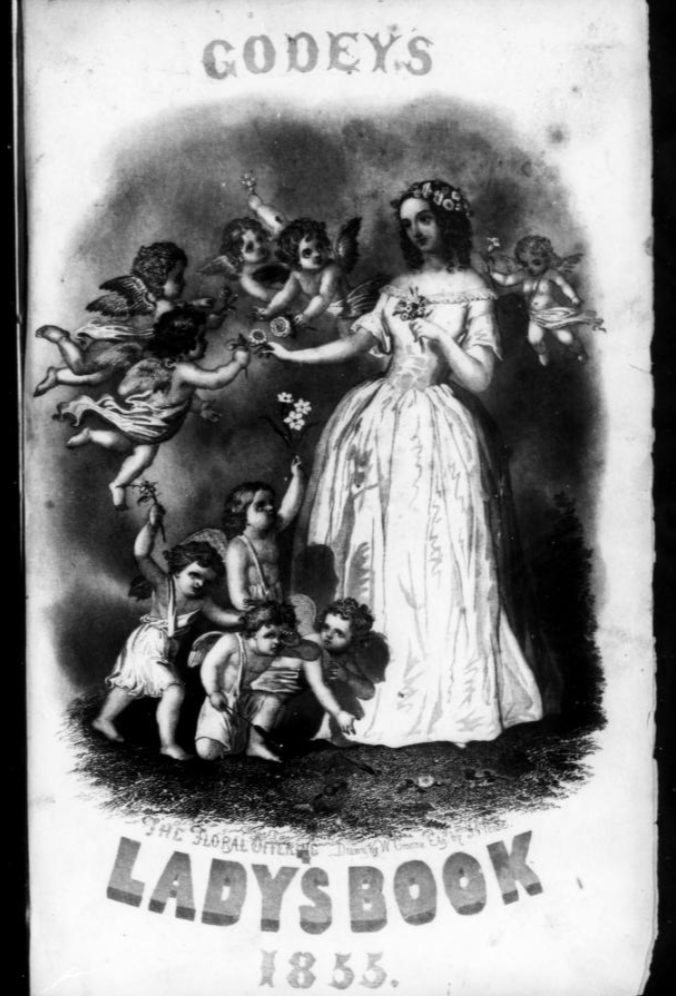
In the current day, magazines are not as popular as they once were. With the rapid progression of social media, much of the information found in magazines, such as clothes or news stories, is easily accessible online. Trends, particularly in women’s clothing, are often covered by influencers who promote the “next best thing” to a large audience all over the world. In the 1800s, there were not many places for women to see what styles were trending. Magazines, such as Godey’s Lady’s Book, became one of the most accessible ways to find out.
Godey’s Lady’s Book was one of the most popular magazines of the 1800s. The magazine, created by Louis A. Godey, began in 1830 and continued to be published up until 1898. During its publication, it was the most influential women’s magazine of its time, having around 150,000 subscribers at its zenith. Under Godey’s governance, the magazine mostly consisted of domestic advice, recipes, and fashion plates, in which the magazine was most famous for. These plates were hand-colored and depicted the most current fashion trends for women and were often cut out and used in a scrapbook or for display. The magazine avoided all topics regarding politics or the Civil War, even as it impacted the lives of readers daily.
In 1837, Godey bought Boston’s Ladies’ Magazine, and with it, came its editress (her term), Sarah Josepha Hale. With Hale as editress, the magazine now included not only recipes and its fashion plates, but also embroidery patterns, the “Editor’s Table” (written by Hale), book reviews, notes of advice, and “Godey’s Arm-Chair”, an editorial column written by Godey. It also included commissions (from Hale) of poetry and essays, almost exclusively from American writers, many of whom were women. Even with new additions made, Godey’s Lady’s Book still remained the most well-known for its hand-colored fashion plates.
The color palettes of 1858 mainly consisted of a darker, more muted palette for daytime dresses and a brighter, more pastel palette for evening dresses. The general rule of attire for women was that daytime dresses had to be high-collared with long sleeves and evening dresses could have low collars and short sleeves. The waistlines for most dresses were natural, although some could be slightly lower based on the bodice design. Dresses were made from silks, woolens, and some cottons. The style of 1858 was built upon the use of many petticoats and wire hoop skirts to support the gathered skirts on top. These skirts billowed at the bottom and gathered in small ruffles at the waistline. Depending on the style of the dress, the fabric of the skirt could be continuous or could sometimes be broken into the several ruffle layers of a flounce skirt. The bodice piece of a daytime dress (which was either a corsage or jacket) was high-collared and long-sleeved. This corsage or jacket was put over a lacy chemisette that was covered all except for the collar. Sleeves gathered over lacy puffs and were tied with ribbon at the ends. To accessorize, small collars of chambray or embroidered voile (fabric types) with matching puffs were added to necklines and sleeves. Fringe, tufts of fabric, or tassels could also be added to basic dress patterns to accessorize.
Eliza Wornall’s wardrobe and parlor were said to be influenced by Godey’s Lady’s Book. Eliza’s personal wardrobe had to have been functional as she engaged regularly in household chores, including cooking and gardening. Her clothing style was most likely influenced partially by her childhood, as she grew up in a Methodist missionary family. Eliza’s wardrobe most likely consisted of five or six dresses in all. She would have owned two or three petticoats and at least one wire hoop skirt. Eliza would most likely have two or three working dresses with gathered skirts, long sleeves, high-necked collars. These dresses were made out of more practical working fabrics, such as wool or cotton. She would also have had one or two “Sunday Best” dresses for church, with long sleeves, high-necked collars, elaborate trim and possibly a flounce skirt. These dresses were most likely made out of nicer, more colorful fabrics such as silk or woolens. There is a possibility, although it is highly unlikely, that she owned an evening gown. Eliza’s accessories consisted of jewelry, shoes, parasols to match her Sunday Best dress, and a work bonnet for everyday.