Throughout the Civil War, Black men had to overcome formidable obstacles long before they ever reached the battlefield. Their efforts to enlist were blocked by deep-seated racism, political fears, and federal laws that rigidly defined citizenship and restricted who could serve the nation in uniform.
The 1792 Law That Drew the Color Line
The exclusion of Black Americans from military service reaches back to the nation’s founding. In 1792, Congress passed the Militia Act, setting federal standards for state militias. Although presented as a national defense measure, its language was clear: only “each and every free able-bodied white male citizen” could participate.
That one phrase did more than simply bar Black men from militia duty. It tied military service—and, by extension, full citizenship—directly to whiteness. Despite the contributions of Black soldiers during the American Revolution, the new law established a national standard of white-only participation, though some states made local exceptions.
Fear of Revolt, Fear of Equality
The exclusion of Black men from militias didn’t begin in 1792; it mirrored earlier colonial and state policies. The 1790s, however, brought heightened anxiety for enslavers. News of the Haitian Revolution sent shockwaves through white communities, especially in the South, and stoked fears of uprisings on American soil.
To many white Americans, keeping Black men—free and enslaved—away from weapons or military training was a necessary precaution. Fear of rebellion didn’t create racist policy, but it certainly strengthened it, drawing lines that would be difficult to erase for generations.
This anxiety intersected with the prevailing view that enslaved people were property, not citizens. If a man could wear a uniform, carry a musket, and fight for his country, how could he remain someone’s legal possession? For many white leaders, it was simpler to forbid Black enlistment than to confront the contradiction head-on.
Lincoln, Border States, and Cautious Politics
When the Civil War broke out in 1861, these old laws and attitudes continued to shape policy. The language of the 1792 statute remained, but in practice, War Department decisions and political calculations—more than legal mandates—kept Black men out of the ranks in the war’s early years.
President Abraham Lincoln worried that moving too quickly to enlist Black soldiers might drive slaveholding border states like Kentucky and Missouri into the Confederacy. Preserving the Union came first, which meant proceeding cautiously on emancipation and Black recruitment.
Some Union generals tried to move faster. Major General John C. Frémont proclaimed freedom for enslaved people owned by rebels in Missouri and allowed them to enlist, but Lincoln quickly revoked the order. Major General David Hunter did something similar in parts of Georgia, Florida, and South Carolina; his efforts to recruit Black soldiers were also struck down.
The message was unmistakable: at the war’s outset, federal policy placed white public opinion and border-state loyalty above the cause of Black participation.
When the War’s Needs Began to Shift
By 1862, the Union could no longer ignore the strain of war. Disease, casualties, and desertion had sapped regiments across the army, and the conflict was proving far longer and bloodier than anyone had expected. The army’s ranks were thinning fast.
At the same time, thousands of enslaved people were fleeing to Union lines, seeking protection and opportunities to aid the cause of their own liberation.
Congress responded with the Second Confiscation Act and the Militia Act of 1862, both passed in July of that year. These laws allowed African Americans to serve in the military, though mostly in labor or support roles at first, and for less pay than their white counterparts. Black manpower was now essential, but equality in service was still out of reach.
From Exclusion to Essential Soldiers
Only after the Emancipation Proclamation took effect in January 1863 did Black recruitment become central to Union war strategy. In May, the War Department created the Bureau of Colored Troops to oversee the United States Colored Troops (USCT) and their organization.
By the war’s end, approximately 179,000 Black men had served as soldiers in the Union Army—about 10 percent of its total forces—and roughly 19,000 had served in the Navy.
Yet equality was still far off. Black soldiers were initially paid less than whites—$10 a month, minus a clothing deduction, compared to $13 for white troops—until Congress addressed the disparity in 1864. Advancement was rare, and Confederate policy often meant capture brought the threat of enslavement or execution, not prisoner-of-war status.
The service and sacrifice of these men laid bare the old justifications for exclusion. Their transformation from barred militia members to indispensable Union soldiers was more than a military policy shift—it marked a fundamental, hard-won redefinition of American citizenship, breaking the old link between military service and whiteness.
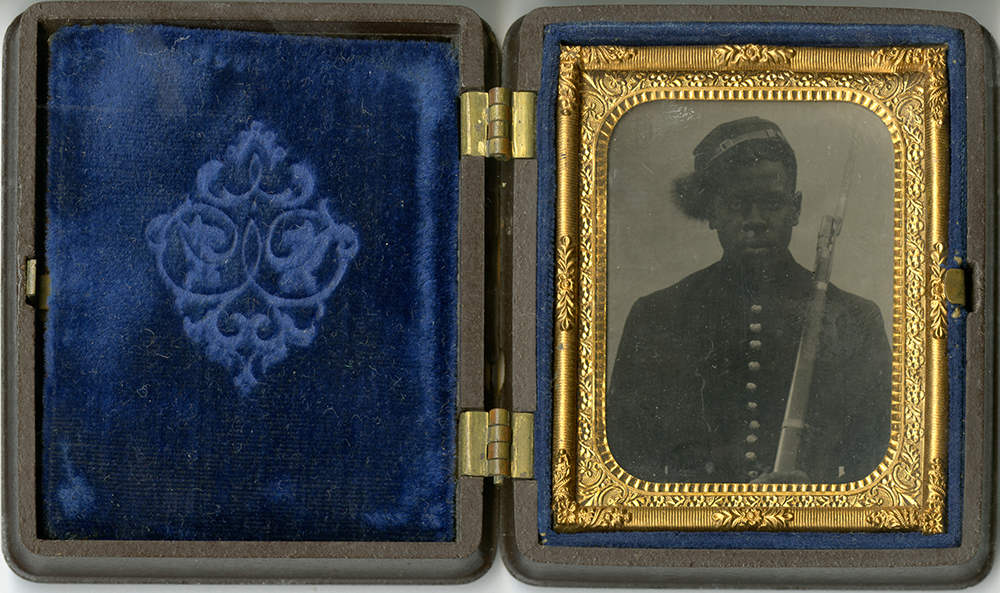
Pictured: ambrotype of Civil War soldier from the Smithsonian National Museum of African American History and Culture.