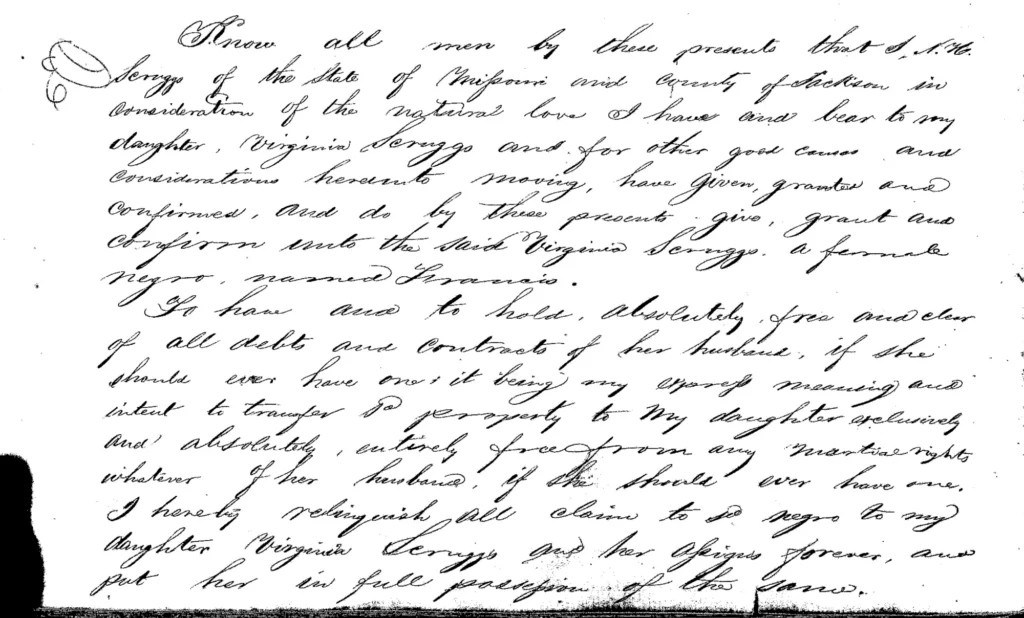
This deed of gift, dated July 18, 1855, shows Nathaniel Scruggs gifting a woman named Francis to his daughter Virginia Scruggs. He expressly states that he gifted the enslaved woman to his daughter “exclusively and absolutely, entirely free from any marital rights whatever of her husband, if she should ever have one.” Virginia was not married in 1855 and would die unmarried two years later.
On the same day, Nathaniel gave an enslaved woman named Vinda to his daughter Ann Scruggs, also free of claims from any future husband. Ann (also known as Anna Eliza) married Joseph McLeod in 1858.
 Married women in 1850 were largely governed by the concept of “coverture,” which meant that a married woman could not freely own or control property. A married woman could not sign contracts or sell land on her own and property she brought into the marriage became her husband’s to manage. However, the Missouri Married Women’s Property Law of 1845 allowed married women to own property if they inherited it or if it was given to them specifically as a separate estate. For white women in Missouri, this often meant the ownership of enslaved people. Owning enslaved people was seen as a way for women to build financial independence, using their slaves to generate profit through labor and reproduction. Nathaniel Scruggs knew that by gifting these enslaved women to his daughters, he was providing future financial security for them in case they were not married, or if they married someone who mismanaged his own funds.
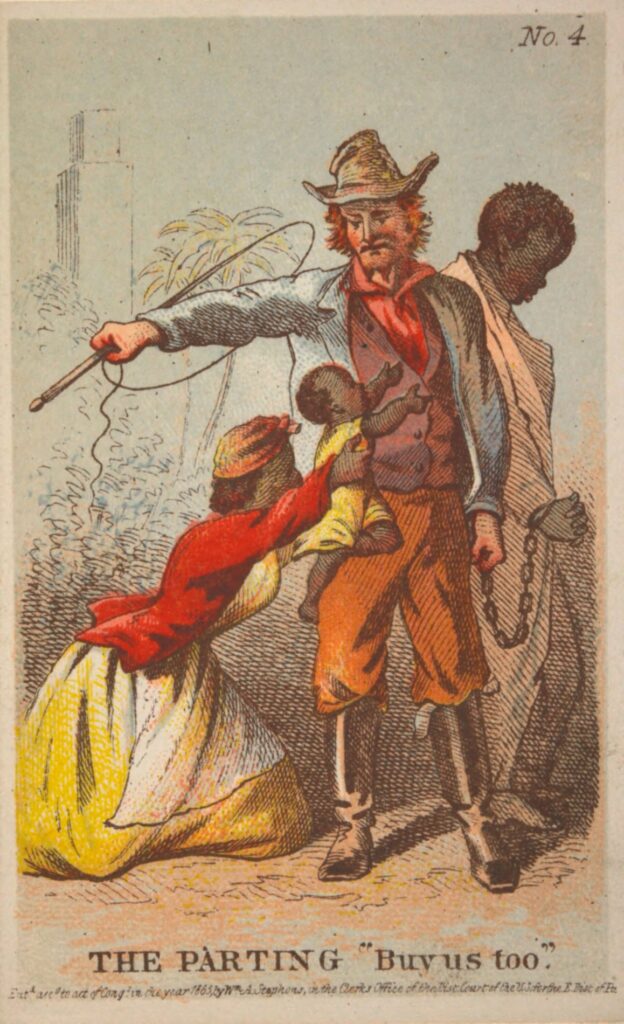
While Nathaniel was thinking of his family, he split another apart. Francis was separated from her mother, Cynthia, and at least two sisters, Virgin Mary and Tamantha Jane. In 1878, Cynthia took out an advertisement in The Daily Kansas Tribune in Lawrence, Kansas, inquiring about the whereabouts of her three daughters. Virgin Mary and Tamantha Jane were enslaved by Thomas Johnson, and Francis had been enslaved by Henry Chick. Most likely, Francis was sold to Chick after the death of Virginia Scruggs in 1857. However, Chick is not listed as a slaveholder in the 1860 U.S. Federal Census Slave Schedule, so Francis may have been sold again between 1857 and the end of slavery in 1865 to an unknown enslaver.
View the document in our database

The Washington Henry Chick cabin, a likely location where Francis was enslaved. Located on Pearl Street in Kansas City, Missouri, burned down in 1895.
Sources/Further Reading:
“Cynthia Scruggs searching for her three daughters ,” The Daily Kansas Tribune (Lawrence, KS), August 13, 1878, Last Seen: Finding Family After Slavery, accessed February 2, 2026, https://informationwanted.org/items/show/3560.
Jones-Rogers, Stephanie E., They Were Her Property: White Women as Slave Owners in the American South. Yale University Press, 2020.
Research completed by Sarah Bader-King, February 3, 2026.